My surgery time was set for 12.05pm on January 24, 2008.
After midnight on January 23rd, 2008 I was told not to eat or drink anything - this included water, chewing gum etc. On that same day before, I made sure I was well hydrated and ate a light, easily digestible meal at dinner. I also snacked on a bagel around 9pm and finished drinking water around 11.30pm.
Considering the events that were going to transpire the next, I got a pretty good nights sleep.
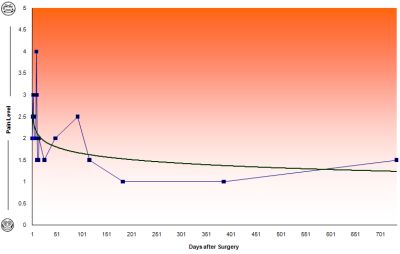
Pain Chart - Post Surgery
Friday, January 25, 2008
Pre Surgery - Pre Surgery Testing
Prior to surgery itself I had to provide the following diagnostic information:-
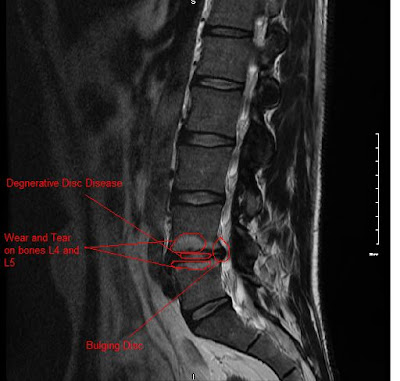
Below is an MRI scan of my back, prior to surgery. I've added some comments to it:-
- Cardiac consent (This necessitated a EKG and in my case an echo cardiogram - due to prior heart surgery)
- PCP (Primary Care Physician - my family doctor) consent (This included a physical exam and some blood work)
- Neuro surgical consent (This necessitated a visit with one of Dr V's assistants, running through a series of tests and signing a surgical consent form)
- Pre Surgery testing (This included visiting the Pre Surgery department of the hosptial I was having surgery at - BCH (Boulder Community Hospital) - and having some extra blood work done, an additional chest x-ray and a "walk through" of what would happen on the day of surgery, including what I would need to do the day before surgery)
Below is an MRI scan of my back, prior to surgery. I've added some comments to it:-

(MRI courtesy of Boulder Community Hospital)

Pre Surgery - Signing up for Wallis Trial with Abbott Laboratories
In order to sign up for the Wallis Trial I had to accomplish amongst other things:-
Abbott Laboratories would be paying for all the surgery costs, but this didn't include anything that would be standard for any kind of surgery i.e. pre-testing for general surgery etc.
- Sign a consent form that I was applying for the Wallis Trial and would commit to the trial requirements
- Fill out a multiple choice questionnaire to verify that I qualified for the trial
- Provide X-rays (showing hyperextension and hyperflexsion of the back) taken in the last 60 days
- Provide MRI scans of the back taken in the last 60 days
- Show that I'd tried Physical therapy for at least 6 months
Abbott Laboratories would be paying for all the surgery costs, but this didn't include anything that would be standard for any kind of surgery i.e. pre-testing for general surgery etc.
Pre Surgery - Surgical Options
Given the conditions below, I decided I should see several back surgeons to review my options. The general consensus was that I would ultimately need back surgery and the best option was disc replacement (essentially cutting out the disc between L4 and L5, inserting metal plates between the two bones and sliding an artificial disc between the two). This is a pretty evasive type of surgery as it is performed anteriorly, involves moving the stomach to one side and comes dangerously close to some key areas of the spine, namely the spinal code and nerves.
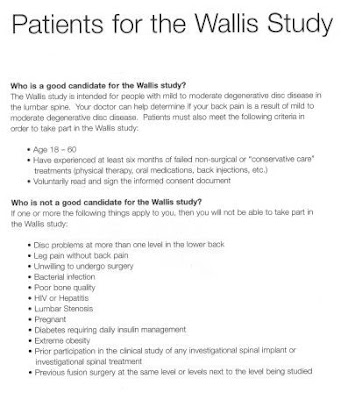
As you can imagine, this is the type of surgery you don't approach lightly. To make sure I'd covered all my bases, I started researching the internet for other options. Around the same time, I happened to read an article in a triathlon magazine about a world class athlete that had somewhat similar conditions to me and had undergone surgery in nearby Boulder, Colorado. Further research indicated that the surgeon's name was Dr. Vilavincencio. During my appointment with Dr V (Villavincencio), I was made aware of a new treatement that was being trialled for the FDA by Abbott Laboratories. The solution was called "Wallis Stabilization System" and was far less evasive than disc replacement surgery and has been performed successfully in Europe for the 14 years or so. Dr V. believed that I qualified for the trial - some of the requirements are listed below:-
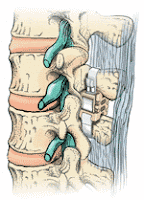
The Wallis device is a small grommit looking object that is inserted, from the back, between the two spinal bones where the degenerative disc disease occurs.
Two straps are tied securely around those two bones and attached to the Wallis device to allow for flexibility. Essentially the Wallis device acts as a shock absorber and sets the spacing between the two bones as it should be with a clean disc.
Based on the information I was given on the Wallis Stabilization system and the fact that the procedure was reversible (since nothing is altered or removed from your body, you can remove the implant and be back where you were), I decided to sign up for the trial
As you can imagine, this is the type of surgery you don't approach lightly. To make sure I'd covered all my bases, I started researching the internet for other options. Around the same time, I happened to read an article in a triathlon magazine about a world class athlete that had somewhat similar conditions to me and had undergone surgery in nearby Boulder, Colorado. Further research indicated that the surgeon's name was Dr. Vilavincencio. During my appointment with Dr V (Villavincencio), I was made aware of a new treatement that was being trialled for the FDA by Abbott Laboratories. The solution was called "Wallis Stabilization System" and was far less evasive than disc replacement surgery and has been performed successfully in Europe for the 14 years or so. Dr V. believed that I qualified for the trial - some of the requirements are listed below:-

(Image courtesy of  )
)
 )
)The Wallis device is a small grommit looking object that is inserted, from the back, between the two spinal bones where the degenerative disc disease occurs.
Two straps are tied securely around those two bones and attached to the Wallis device to allow for flexibility. Essentially the Wallis device acts as a shock absorber and sets the spacing between the two bones as it should be with a clean disc.


Based on the information I was given on the Wallis Stabilization system and the fact that the procedure was reversible (since nothing is altered or removed from your body, you can remove the implant and be back where you were), I decided to sign up for the trial
Pre Surgery - Diagnosis of Condition
In the early summer of 2006, during a long bicycle ride, while dismounting from my bike I felt a painful twinge in my lower back. At the time I didn't think much about it and continued with my triathlon training.
Over the course of the next few weeks, the pain intensified so I started getting some physical therapy treatment which while alleviating the pain, didn't resolve the underlying issue ... whatever that happened to be.
I continued through the pain and successfully completed my first half ironman race and started training for my first marathon in the autumn of 2006. During my marathon training, for some reason, I felt little to no back pain. I successfully finished the marathon (3:45hr for those interested) and decided to take some time off from training after that.
At this point the pain intensified and I started seeing the physical therapist more and more, including some acupuncture treatment. Some days I won't feel any pain at all, other days I'd have sudden sharp pains in my lower back - very much like someone stabbing me in the spine. The pain didn't last long, but was intense and debilitating.
The physical therapist agreed that while we were temporarily relieving the pain, we weren't fixing the underlying condition, so we decided to get an MRI scan to investigate the cause further
The MRI scan revealed that I had the following conditions:-
Over the course of the next few weeks, the pain intensified so I started getting some physical therapy treatment which while alleviating the pain, didn't resolve the underlying issue ... whatever that happened to be.
I continued through the pain and successfully completed my first half ironman race and started training for my first marathon in the autumn of 2006. During my marathon training, for some reason, I felt little to no back pain. I successfully finished the marathon (3:45hr for those interested) and decided to take some time off from training after that.
At this point the pain intensified and I started seeing the physical therapist more and more, including some acupuncture treatment. Some days I won't feel any pain at all, other days I'd have sudden sharp pains in my lower back - very much like someone stabbing me in the spine. The pain didn't last long, but was intense and debilitating.
The physical therapist agreed that while we were temporarily relieving the pain, we weren't fixing the underlying condition, so we decided to get an MRI scan to investigate the cause further
The MRI scan revealed that I had the following conditions:-
- Mild degenerative disc disease between L4 and L5
- A bulging disc between L4 and L5
- Mild stenosis
Introduction
This blog is a diary of my back surgery experience. The reason for this is that I was fortunate enough to be part of a FDA trial using a new back implant, called a Wallis Stabilization device. At this stage, in Phase 2 of the trail, I'm one of the first few people to receive such an implant. As such, this is aimed at anyone else that is contemplating this type of surgery and would like one man's insight into the procedure and recovery
Subscribe to:
Posts (Atom)
